
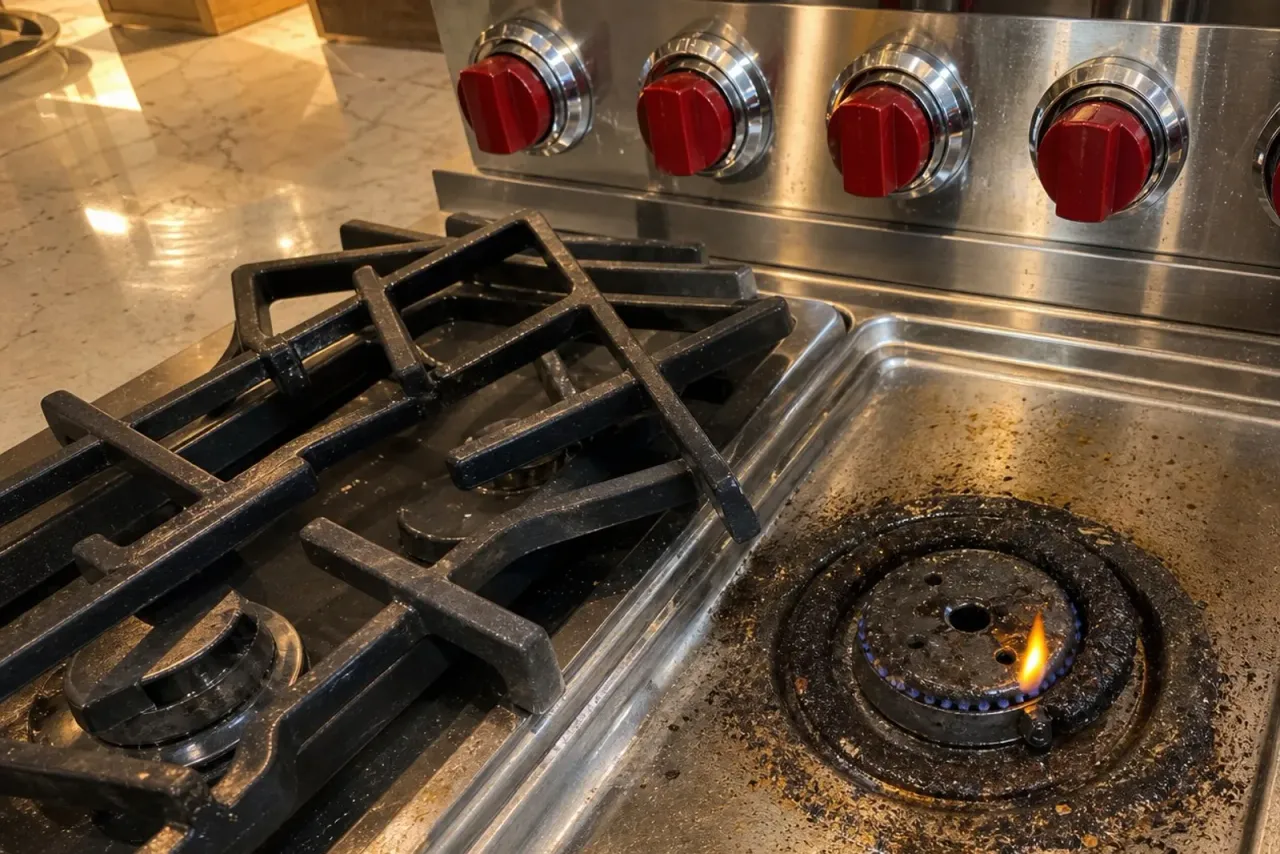
Burner will not light
On both open- and sealed-burner ranges this is usually a fouled cap, a worn spark electrode, or an igniter/module fault. Clean and reseat the cap first; persistent failure needs service.
Troubleshooting
Diagnose common Viking range, oven and refrigerator problems: burner ignition, oven temperature, cooling and door issues. Owner-safe checks plus when to call a pro.

Viking brought commercial-style cooking and refrigeration into the home, and its heavy-gauge ranges and built-in refrigerators are designed to be repaired and kept rather than replaced. Because Viking spans both open-burner and sealed-burner ranges, gas and dual-fuel ovens, and professional refrigeration, the same symptom can have different causes depending on your model generation. This guide explains the most common Viking problems, their likely causes, and the safe checks you can run yourself.
We are an independent company that has specialized in Viking and other high-end appliances since 2005, serving the San Francisco Bay Area from Los Gatos. We have written this to be genuinely useful and technically accurate. Where a repair touches gas, refrigerant, or live electrical systems, we say clearly that a qualified technician is required rather than offering risky do-it-yourself steps.
For Viking cooking appliances, confirm the gas supply is on for gas models or that the dedicated breaker has not tripped for electric and dual-fuel models. For refrigeration, check that the unit is plugged in or the breaker is on, that the temperature has not been changed accidentally, and that the doors are closing and sealing fully. A quick power cycle at the breaker can clear a stuck control on either type of appliance.
With ranges, let the cooktop cool and verify that burner caps and grates are clean and properly seated. With refrigerators, one of the most overlooked maintenance items is the condenser coil: dust buildup makes the unit run warm and loud. Cleaning accessible coils per your manual is owner-safe and often resolves marginal cooling and noise. Adjusting gas components, opening the sealed refrigeration system, or accessing internal wiring is not owner-safe and requires a technician.
Both classic open-burner and newer sealed-burner Viking ranges rely on spark electrodes and igniters that can foul or wear over time. A burner that clicks without lighting usually needs the cap cleaned and reseated first; if it still will not light, the spark electrode, igniter, or spark module typically needs testing and replacement. A weak flame or poor simmer points to a clogged orifice or a gas-pressure or burner-tuning issue, which is a technician task because it involves the gas system.
If an oven will not hold temperature, the common causes are a failed heating element on electric and dual-fuel models, a weak igniter on gas ovens, or a drifting thermostat or sensor. Confirm the problem with a separate oven thermometer before service so you can describe the behavior accurately.
Viking refrigeration problems often come down to airflow and the defrost system rather than the compressor. If the unit is running warm, first confirm the coils are clean, the condenser fan area is clear, and the doors seal tightly. Beyond those owner checks, common causes include a failed evaporator fan, a defrost heater or thermostat fault that lets the coil ice over, or a temperature sensor or control-board issue. If food is freezing in the fresh-food section, that usually points to a sensor or control fault.
Compressor and sealed-system problems, including any work involving refrigerant, must be handled by a qualified, EPA-certified technician. These are not do-it-yourself repairs, and we will tell you honestly when that is what your unit needs.
Viking ovens with self-clean cycles use a door latch motor and thermal limits that can fail after a high-heat cycle, leaving the door locked or the oven inoperative. This involves the latch mechanism and protective components and should be diagnosed by a technician. Call a qualified professional for any gas-system adjustment, refrigerant or sealed-system work, control-board faults, or live-electrical repairs. Owner-safe steps such as cleaning coils, reseating burner caps, checking door seals, and power-cycling are always worth trying first. For diagnosis on anything beyond that, reach our team at (650) 668-1554.
Common Viking symptoms
On both open- and sealed-burner ranges this is usually a fouled cap, a worn spark electrode, or an igniter/module fault. Clean and reseat the cap first; persistent failure needs service.
Typically a clogged orifice, low gas pressure, or a burner needing tuning. These gas-system adjustments require a qualified technician.
Commonly a failed element, a weak gas oven igniter, or a drifting thermostat/sensor. Verify with a separate thermometer before calling for service.
Often dirty condenser coils, a failed evaporator fan, or a defrost fault icing the coil. Clean coils and check door seals first; deeper faults need diagnosis.
Usually a temperature sensor or control-board fault sending the wrong cooling signal. This requires technician diagnosis.
A self-clean cycle can fault the latch motor or trip a thermal limit. The latch and protective components should be checked by a technician.
Frequently dirty condenser coils making the unit work harder, or a worn fan motor. Clean accessible coils; ongoing noise warrants service.
FAQ
Yes. We regularly diagnose both the classic open-burner Professional ranges and newer sealed-burner models. Ignition behavior differs between them, so identifying your model helps us pinpoint the cause of a burner that will not light.
Start with owner-safe items: confirm the temperature setting, make sure the doors seal fully, and clean the condenser coils if accessible. If it still runs warm, the cause is often an evaporator fan, defrost fault, or sensor issue that needs technician diagnosis.
No. Refrigerant and sealed-system work must be performed by a qualified, EPA-certified technician. It is unsafe and illegal to handle refrigerant without certification, and a proper diagnosis first confirms whether the sealed system is actually the problem.
Self-clean cycles use a latch motor and thermal limits that can fault under high heat. Do not force the door. The latch mechanism and protective components should be inspected by a technician to restore normal operation safely.
Subzero Repair · Open 24/7 · 365-day warranty
Call for urgent cooling or cooking failures, or book online for a service window across the Bay Area.