
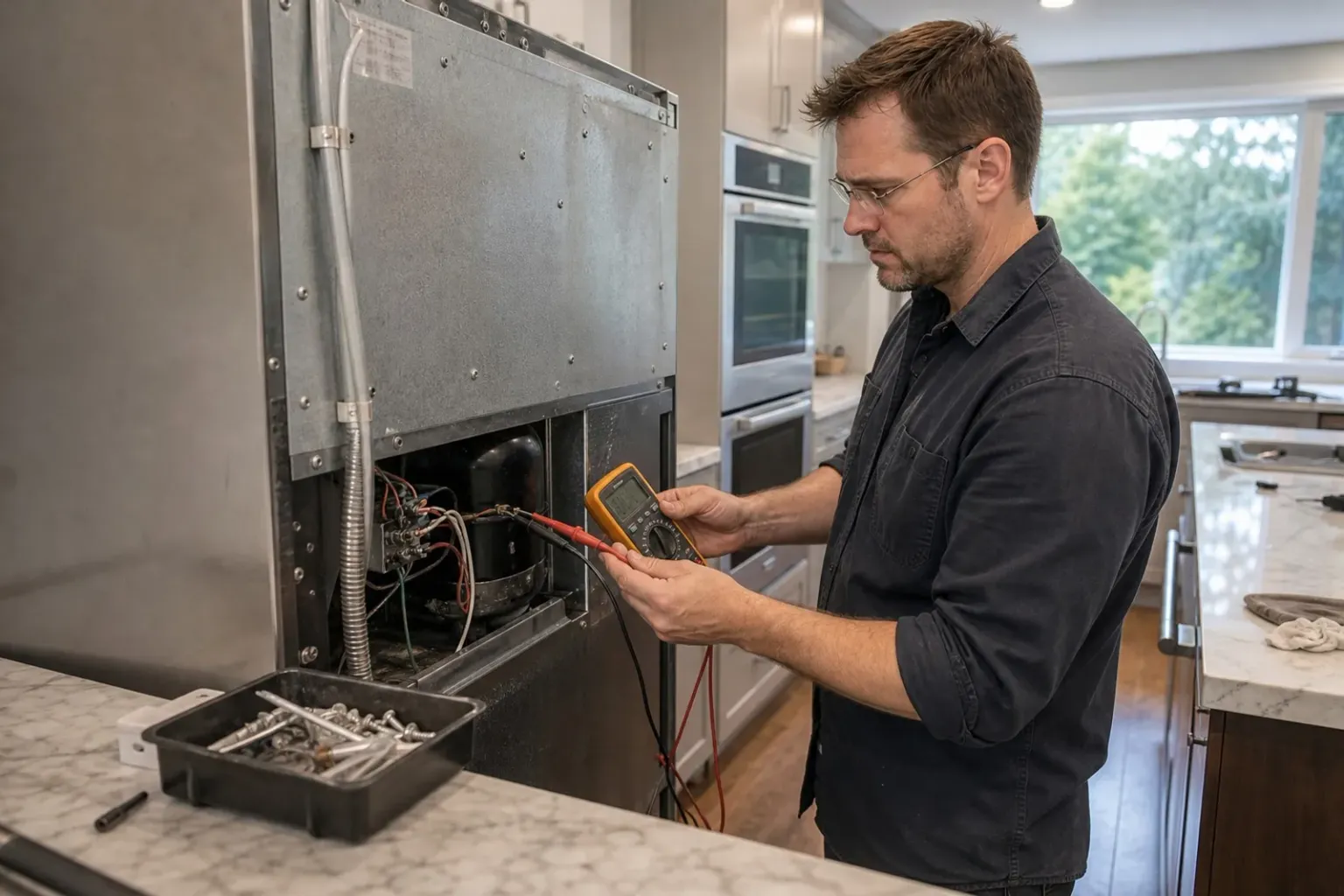
Repair guide
How to Clean the Condenser Coils on a Sub-Zero Refrigerator
Step-by-step guide to safely cleaning your Sub-Zero condenser coils to fix warm temperatures and improve efficiency. Owner-safe, every 6-12 months.
Cleaning your Sub-Zero condenser coils is an owner-safe task that takes about 15 minutes and is the most common fix for a fridge that runs warm or runs constantly. On most Sub-Zero built-in models the condenser is behind the front grille at the top of the unit, so you do not need to pull the refrigerator out. You only need a vacuum with a brush attachment and a soft brush.
Sub-Zero recommends cleaning the coils roughly every 6 to 12 months, and more often in homes with pets or heavy dust. Dust-clogged coils trap heat, force the compressor to work harder, raise temperatures, and shorten the unit's life. Regular cleaning restores cooling and efficiency.
Why dirty coils cause warm temperatures
The condenser releases the heat removed from inside the fridge. When its coils and fins are coated in dust, lint, and pet hair, they cannot shed heat efficiently. The compressor then runs longer and hotter trying to keep up, which shows up as warm food, ice cream that won't stay firm, longer run cycles, and higher energy bills.
In severe cases, restricted airflow can trip a high-temperature condition or cause the compressor to overheat and shut down. Cleaning the coils is the first thing to check whenever a built-in fridge starts running warm.
How often to clean the coils
Every 6 to 12 months is the general guideline. Clean more frequently, around every 3 to 4 months, if you have shedding pets, run a busy kitchen, or live in a dusty area. A quick look behind the grille every few months tells you whether buildup is forming.
Make it a routine, for example tied to a seasonal change, so it is not forgotten. Consistent cleaning prevents the gradual temperature creep that owners often mistake for a failing compressor.
When cleaning the coils is not enough
If the coils are clean and the fridge is still warm, the problem is elsewhere: a failing condenser or evaporator fan, a defrost system fault, a bad sensor or control board, or a sealed-system issue such as low refrigerant. Refrigerant and sealed-system work require an EPA-certified technician and cannot be done DIY.
If temperatures do not improve within 24 hours of a thorough coil cleaning, or you hear unusual clicking, buzzing, or the compressor cycling rapidly, call a specialist for diagnosis.
Step by step
- Locate the grille and turn off power. Find the front grille at the top of the unit. For safety, switch the unit off at its control panel or shut off the circuit, since you will be near the condenser fan.
- Remove the front grille. Most Sub-Zero grilles lift up and out or are held by clips or screws at the top. Gently release it and set it aside. Do not force it; check your model's grille type.
- Vacuum the coils and fins. Use a vacuum with a soft brush attachment to remove dust from the condenser coils and surrounding area. Work top to bottom and avoid bending the thin fins.
- Brush out stubborn buildup. Use a soft brush or coil brush to loosen packed dust between fins, then vacuum again. Clean the fan blade area gently if accessible. Do not use water or solvents.
- Reinstall the grille and restore power. Replace the grille securely, restore power, and confirm the unit restarts. Temperatures should improve over the next several hours.
FAQ
Questions & answers
How often should I clean my Sub-Zero condenser coils?
Every 6 to 12 months for most homes, or every 3 to 4 months if you have pets or a dusty environment. Regular cleaning prevents warm temperatures and reduces strain on the compressor.
Do I need to pull the refrigerator out to clean the coils?
No. On most Sub-Zero built-in models the condenser is behind the front grille at the top, so it is accessible from the front without moving the unit.
What if cleaning the coils doesn't fix the warm fridge?
If temperatures don't improve within about 24 hours, the cause may be a fan, defrost component, sensor, or a sealed-system issue. Sealed-system and refrigerant work require a certified technician.
Subzero Repair · Open 24/7 · 365-day warranty
Rather leave it to a specialist?
Call for urgent cooling or cooking failures, or book online for a service window across the Bay Area.